
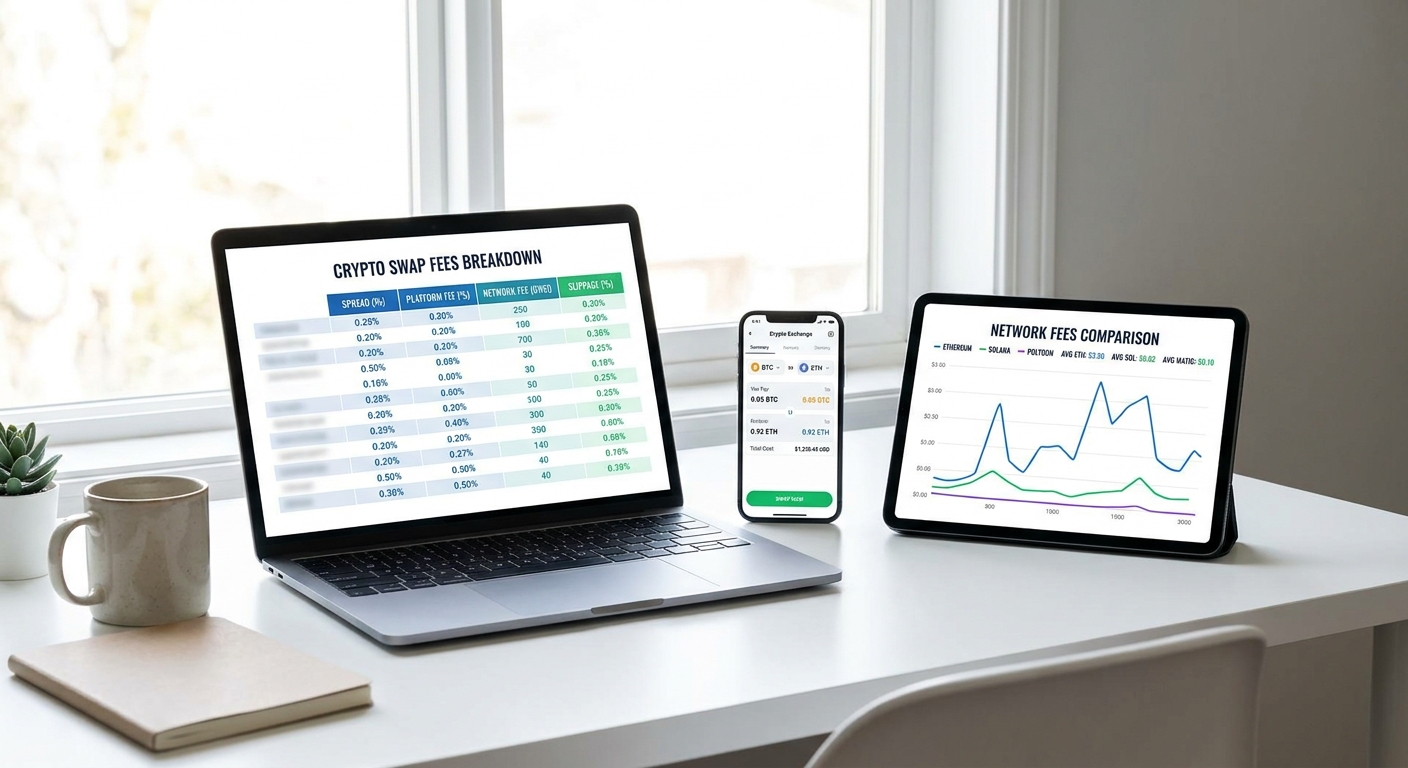
Crypto swaps have become a core part of digital asset management, but the cost of executing one is rarely as straightforward as the advertised fee. There is no single swap fee—instead, the total cost usually combines a spread or markup, a platform or service fee, and a network fee, with slippage sometimes adding even more. Understanding where each cost comes from and how they combine is essential if you want to minimize what you pay and maximize the crypto you receive.
This article will break down the complete fee structure across centralized exchanges (CEX), decentralized exchanges (DEX), and instant swap services. You’ll see how fees change based on asset type, blockchain, and market conditions—and you’ll get a practical framework to compare quotes before you confirm.
What Determines the Cost of a Crypto Swap?
The total cost of a crypto swap is the sum of multiple components, some visible and some hidden in the quoted rate. Understanding each one helps you recognize where your money goes and which costs you can reduce.
The Main Cost Components
| Component | What It Is | Who Receives It | Typical Range |
|---|---|---|---|
| Spread/Markup | Difference between market price and quoted price | Platform or liquidity provider | 0.1–2% depending on pair and liquidity |
| Platform/Service Fee | Explicit commission charged by the swap service | Platform (DEX protocol, CEX, or aggregator) | 0.05–0.5% for CEX; 0.25–1% for DEX |
| Network/Gas Fee | Blockchain transaction cost to settle the swap on-chain | Network validators and miners | $0.50–$50+ depending on chain and congestion |
| Slippage | Price movement between quote and execution | Market participants (lost to price movement) | 0.1–5%+ on large or illiquid pairs |
| Fixed-Rate Premium | Additional markup on instant or time-locked swaps | Platform offering the fixed rate | 1–3% for guaranteed price locks |
Slippage is not technically a fee but still reduces the value you receive. It occurs when the execution price differs from the quoted price, often because the market moved or your trade is large relative to available liquidity. Spread and slippage are often used interchangeably but come from different sources: spread is the platform’s built-in margin, while slippage is the cost of your trade’s impact on the market.
Why the Same Swap Costs Different Amounts
A swap from Bitcoin to Ethereum might cost one user $5 and another $50, even at the same platform. The reason is that several factors change the final price.
Pair liquidity is the biggest driver. Swapping between two highly traded assets like BTC and ETH on a major platform costs far less than swapping into a new or low-volume token. Poor liquidity widens the spread and increases slippage, especially for larger trades.
Chain congestion directly affects network fees. Ethereum during peak hours can charge $15–$50 for a single swap, while Solana might charge $0.02 at the same time. If you’re swapping on a chain with fewer validators or higher demand, you’ll pay more just for the transaction to settle.
Trade size matters too. A $100 swap and a $100,000 swap might have the same percentage fee, but the larger trade will experience much larger slippage if liquidity isn’t deep enough.
Platform type changes cost structure entirely. A centralized exchange bundles fees into a visible taker fee but may offer deeper liquidity and lower spreads. A decentralized exchange charges a liquidity provider fee but exposes you to gas costs. An instant swap service quotes an all-in rate that includes everything but gives you less control over execution.
Typical Fee Ranges by Swap Type
Different swap platforms operate under different fee models. To choose the cheapest option for your specific swap, you need to know how each model prices a transaction.
| Swap Type | Advertised Fee | Hidden/Embedded Cost | Typical All-In Cost | Best For |
|---|---|---|---|---|
| CEX (Centralized Exchange) | 0.1–0.5% taker fee | 0.1–0.5% spread; deposit/withdrawal fees; slippage on illiquid pairs | 0.5–2% total | High-volume traders; stable pairs; regulatory comfort |
| DEX (Decentralized Exchange) | 0.25–1% LP fee | 0.2–1% slippage depending on liquidity; network gas fee (varies by chain) | 0.5–3%+ total | DeFi users; low-fee chains; longer time horizons |
| Instant Swap Service | Quote-based markup | 1–3% fixed-rate premium; network fee built-in or separate | 1–4%+ total | Speed; simplicity; no KYC; small to medium trades |
CEX vs DEX vs Instant Swap Pricing
| Platform Model | Fee Model | Network Cost Exposure | Typical Cost Profile |
|---|---|---|---|
| CEX | Maker/taker commissions; spread on quoted pairs | Withdrawal fee separate; deposit often free | Low headline fee but centralized control; hidden fees for deposits/withdrawals |
| DEX | Liquidity provider percentage (0.25–1%); protocol fee | Gas/network fee per transaction; fully on-chain | Transparent fees but volatile network costs; slippage depends on pool depth |
| Instant Exchange | Quote-based markup; fixed-rate lock optional | Network fee included or itemized separately | Highest headline cost but all-in simplicity; best for cross-chain or urgent swaps |
Hidden Costs That Change the Final Price
Beyond the headline fee, several embedded and variable costs reduce the amount of crypto you actually receive. Recognizing them helps you spot which platforms or methods are genuinely cheaper.
- Spread (bid-ask difference): The gap between what a market maker will buy at and sell at. Tighter spreads mean lower cost.
- Slippage: The difference between the price shown at quote time and the actual execution price. Larger on low-liquidity pairs and bigger trades.
- Network/gas fee: The blockchain cost to settle the transaction. Varies by chain, congestion, and transaction complexity.
- Withdrawal fee: Charged by CEX platforms when you move crypto off the exchange (often $1–$10 per asset).
- Deposit fee: Less common but charged by some platforms when you move crypto in; usually 0–0.5%.
- Approval fee: On some DEX platforms, you must approve the token contract before the first swap, incurring a separate network fee.
- Fixed-rate premium: Extra cost if you want to lock in a price for 30 minutes or more instead of accepting the live rate.
Spread, Slippage, and Price Impact
Spread and slippage are often confused but work differently. A spread is built into the platform’s quoted price—it’s profit for the market maker. Slippage is the additional price movement your trade causes in the market.
If a DEX shows BTC/USDT at $45,000 to buy but the actual fill happens at $45,225, you’ve experienced $225 of slippage on a 0.5% move. On a $100,000 trade, that’s $500. Large trades into shallow liquidity pools produce slippage of 2–5% or more; small trades might slip only 0.1–0.3%.
CEX platforms often hide slippage by quoting a tight spread on major pairs. But if you’re trading a less liquid pair or moving significant volume, you’ll see the spread widen automatically—that’s the platform adjusting to your trade size.
Withdrawal, Deposit, and Conversion Fees
Many crypto swaps actually involve two transactions: the swap itself, and then a withdrawal from the platform where you swapped. A CEX might charge 0.1% to swap BTC to ETH, but then add a $2–$5 ETH withdrawal fee. An instant swap service might quote a 2% rate but charge an extra $0.50–$1 network fee on top.
Some platforms bundle these into the displayed rate, so you see only one number. Others itemize everything. The platforms that itemize are usually more transparent, but you need to add everything up before comparing.
How Fees Differ Across Popular Blockchains
The blockchain you choose for a swap directly affects total cost. Ethereum is more expensive than Solana; Bitcoin is less flexible than Layer 2 networks. Understanding the typical cost per chain helps you choose the right venue for your swap size.
Network Fees by Chain
| Blockchain | Typical Gas/Network Fee | High-Congestion Range | Cost Implications |
|---|---|---|---|
| Ethereum (L1) | $2–$10 | $15–$100+ during peak hours | Best for larger swaps ($1,000+); small swaps eaten by fees |
| Bitcoin | $1–$5 (varies with mempool) | $5–$25 during congestion | Low-frequency; high fees make small swaps uneconomical |
| Solana | $0.00025–$0.001 | $0.01–$0.05 even during congestion | Ideal for small and frequent swaps |
| BNB Chain | $0.10–$0.50 | $1–$5 during high activity | Good middle ground; cheap but more centralized than Ethereum |
| Tron | $1–$5 (in USDT/USDC, not gas) | $1–$10 during congestion | Low cost; strong stablecoin ecosystem |
| Polygon/Arbitrum | $0.01–$0.10 | $0.10–$1 even during congestion | Best for small swaps; Ethereum compatibility |
The chain choice matters most for small swaps. A $50 swap on Ethereum costs 20–40% in network fees alone. The same swap on Solana costs less than 1%. But large swaps benefit from Ethereum’s deeper liquidity and security, and the 0.5% improvement in spread can outweigh the higher gas cost.
Real-World Cost Examples
To understand how fees actually stack up, let’s look at two realistic scenarios: a small swap and a larger one.
| Swap Example | Quoted Fee | Network Fee | Slippage/Spread | Estimated Total |
|---|---|---|---|---|
| Small swap: $200 USDC → ETH on Uniswap (Ethereum) | $0 (0.25% LP fee) | $8 | 0.2% ($0.40) | $8.40 total = 4.2% |
| Small swap: $200 USDC → ETH on Solana DEX | $0 (0.25% LP fee) | $0.01 | 0.2% ($0.40) | $0.41 total = 0.2% |
| Medium swap: $2,000 BTC → ETH on Kraken | $2 (0.1% taker) | $5 (ETH withdrawal) | 0.1% ($2) | $9 total = 0.45% |
| Large swap: $50,000 USDC → ETH on Uniswap v3 (Ethereum) | $0 (0.25% LP fee) | $15 | 0.5% ($250) | $265 total = 0.53% |
Small Swap Example
A $200 swap on Ethereum illustrates why chain choice matters for small trades. You want to convert $200 USDC to ETH on Uniswap, a popular DEX. The liquidity provider fee is 0.25%, or $0.50, but the network gas fee is $8. Slippage adds another $0.40 because the pool is relatively deep but your $200 is still noticeable at that moment.
Total cost: $8.90, or 4.5% of your $200. You receive $191.10 worth of ETH instead of $200. On a low-fee chain like Solana, the same swap costs less than $0.50 total.
This is why small swaps should nearly always happen on low-fee chains. The absolute network cost is small, but as a percentage of your trade, it dominates.
Larger Swap Example
Now swap $50,000 USDC to ETH on the same Uniswap pool. The 0.25% fee is now $125. Network fees are $15. Slippage is larger because $50,000 moves the pool more: 0.5%, or $250.
Total cost: $390, or 0.78% of your $50,000. Percentage-wise, this is cheaper than the small swap. But in absolute dollars, the cost is higher because your trade is bigger. A 0.1% better rate would save $50, making quote comparison worthwhile at this scale.
On a CEX like Kraken, the same swap might quote 0.1% taker fee ($50) plus a $5 ETH withdrawal, totaling $55 plus any spread (0.1–0.2%, or $50–$100). You’d receive roughly the same amount but with more certainty and less slippage risk.
How to Reduce Crypto Swap Fees
The lowest-cost swap is not always the one with the smallest advertised fee. By following these practical tactics, you can reduce total cost without sacrificing speed or security.
- Use a low-fee blockchain for small swaps: Solana, Polygon, and Arbitrum charge $0.01–$0.10 per swap. Ethereum charges $5–$20. For swaps under $1,000, the chain fee often matters more than the percentage fee.
- Choose stablecoin and major asset pairs: BTC/USDT and ETH/USDC have the deepest liquidity, tightest spreads, and lowest slippage. Swapping into new or low-volume tokens is always more expensive.
- Avoid congested times: Network fees spike during crypto volatility and market excitement. If your swap can wait 1–2 hours, the network fee often drops by 50–75%.
- Compare fixed-rate vs floating-rate quotes: Instant swap services offer both. Floating rates are cheaper but exposing you to slippage. Fixed rates lock your outcome but cost 1–3% extra. For large swaps, the fixed-rate premium often exceeds the slippage risk, so floating is cheaper.
- Get quotes from multiple platforms: A 0.5% difference in spread between two DEXs or CEXs translates to real money on large swaps. Spend 30 seconds checking two or three sources.
- Confirm the final receive amount, not just the fee percentage: A platform quoting 0.5% fee but with 1% spread might cost more than one quoting 1% fee with 0.2% spread. Always look at the actual crypto amount you’ll receive.
How to Compare Swap Platforms Before You Confirm
Before you execute any swap, use this checklist to evaluate whether the quote is competitive and transparent.
Quote Checklist
| Checkpoint | Good Sign | Red Flag |
|---|---|---|
| Total receive amount is shown | You see the exact crypto you’ll get, not just a fee percentage | Quote only shows fees; you have to calculate the receive amount yourself |
| Network fee is itemized separately | Gas or network fee is shown as a line item | Network fee is hidden or “included” but not visible |
| Slippage warning is provided | DEX shows estimated slippage range (0.1–0.5%) or CEX shows spread | No slippage warning; spread is unlisted |
| Multiple quotes available for comparison | You can get quotes from 2+ platforms without friction | Locked into one platform; hard to check alternatives |
| Fixed-rate cost is disclosed | Fixed-rate lock premium is shown as a separate percentage or dollar amount | Fixed rate is bundled with no way to see the actual premium |
Best Choice by User Type
Not every user needs the cheapest absolute swap. Your priorities determine which platform makes the most sense.
- Beginners: Centralized exchange (Kraken, Coinbase). Higher fees, but they’re simple, safe, and fully transparent. You won’t be surprised by hidden costs or lose crypto to slippage.
- Active traders: Centralized exchange or CEX-linked DEX aggregator (1Inch, 0x). You benefit from best-execution routing and tighter spreads on high-volume pairs. Fees are lower than retail but higher than liquidity providers see.
- DeFi users on Ethereum: Direct DEX (Uniswap, Curve). You understand gas costs and slippage, and you benefit from protocol incentives and deeper liquidity pools. Cheapest for major pairs if you swap at off-peak hours.
- Low-fee chain users: DEX on Solana, Arbitrum, or Polygon (Raydium, Uniswap v3, QuickSwap). Network fees are negligible, so you optimize purely on spread and LP fees.
- Privacy or speed seekers: Instant swap service (ShapeShift, Thorchain, or similar). You pay a premium (1–3%) but you don’t need to register, and settlement is fast. Worth it if your alternative is using a KYC exchange.
Quick Answer: What Is the Cheapest Way to Swap?
The cheapest way to swap depends on your swap size and patience. For swaps under $500, use a low-fee blockchain like Solana—the network fee is so low that it dominates, and percentage-based spreads barely matter. For swaps over $2,000 on Ethereum or Bitcoin, check both a CEX and a DEX aggregator (like 1Inch) and compare the final receive amount, not just the fee label.
Always confirm the total you’ll receive before you sign. The advertised fee is rarely the true cost. Your actual cost is the sum of the spread, the platform fee, the network fee, and the slippage—and only the final receive amount tells you what that total is.