
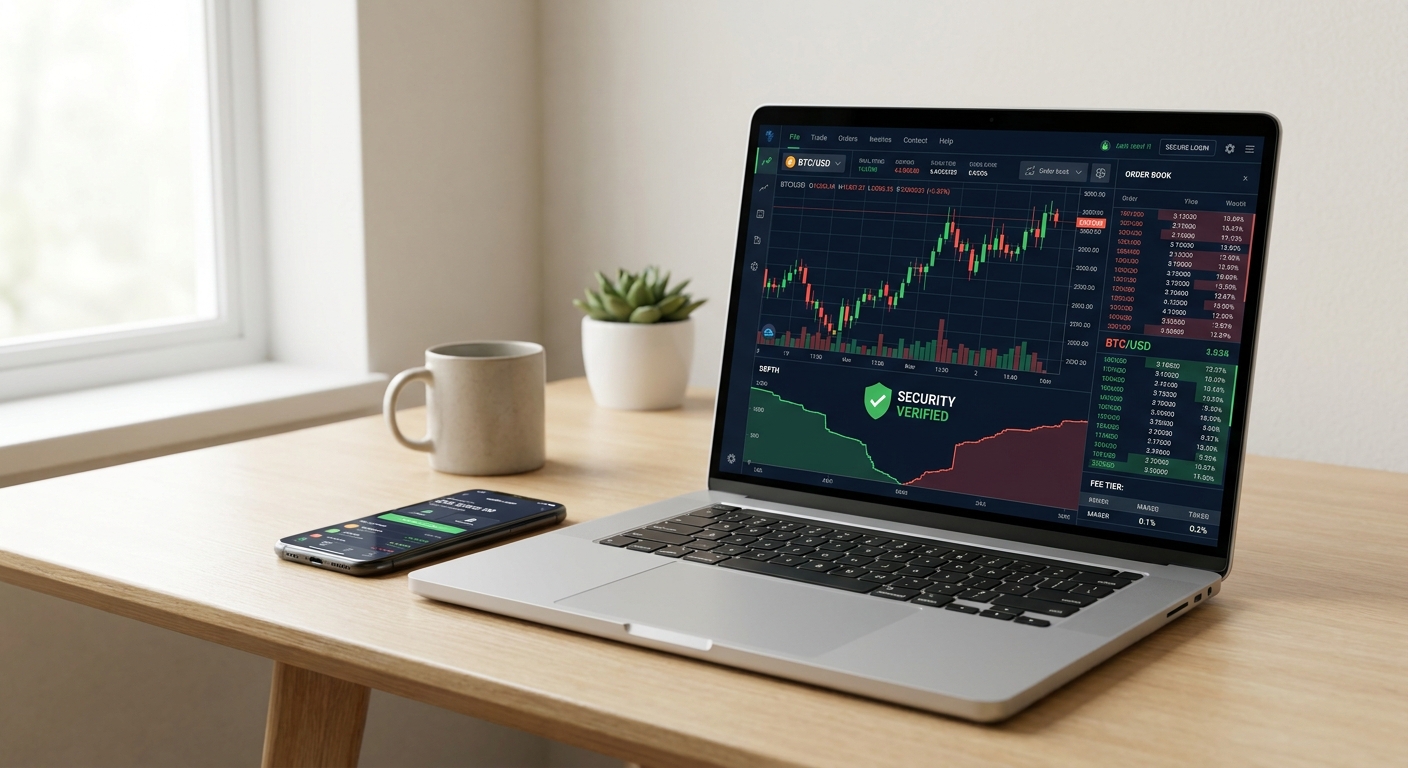
Choosing a crypto exchange is one of the most important decisions any trader or investor makes. Your exchange choice affects your security, your costs, the quality of your trades, and even your access to assets. Yet many people pick an exchange based on a single feature—low fees, a catchy name, or a friend’s recommendation—without evaluating the full picture.
This article flips that approach. Instead of a generic explainer, we’ll build a practical buyer’s checklist that covers 15 specific features across five core evaluation pillars: security, compliance, liquidity, cost, and usability. The best crypto exchanges combine excellence across all these dimensions, but no single exchange dominates every category. Your job is to understand the trade-offs, weight them against your own trading style, and pick the exchange that aligns with your priorities.
What a Good Crypto Exchange Should Do Well
A crypto exchange is a platform that enables users to buy, sell, and trade cryptocurrencies against fiat currencies or other digital assets. But a good exchange goes far beyond basic order matching. It must simultaneously protect user funds, provide reliable market access, keep costs low, execute trades fairly, and offer responsive support—often under extreme market conditions.
Evaluating an exchange effectively means examining five core dimensions: safety (funds protection and account security), access (asset range, market quality, and geographic availability), cost (all fees from deposits to withdrawals), execution (uptime, order matching, and trade quality), and support (responsiveness and problem resolution). These five pillars form the lens through which you should assess any exchange.
The 15 features we’ll explore act as a practical scoring framework. Each feature tells you something concrete: whether funds are actually safe, whether markets are liquid enough for your order size, whether support exists when you need it, and whether hidden costs will erode your returns. Not every exchange excels in every category, and that’s okay—what matters is understanding where each exchange stands so you can make an informed choice.
The Five Core Buying Criteria
| Criterion | Why it matters | What to check |
|---|---|---|
| Security | Losses from theft, hacks, or mismanagement are permanent. | Cold storage %, 2FA enforcement, insurance, audit dates, incident history. |
| Liquidity | Thin order books cause slippage, partial fills, and execution delays. | Spot volume, order book depth, bid-ask spread, 24h trading volume trends. |
| Compliance | Regulatory pressure can freeze accounts or shut down exchanges. | Licensing status, KYC clarity, fiat partnerships, jurisdictional coverage. |
| Fees | Hidden costs compound—spreads, withdrawal fees, and deposits add up fast. | Maker/taker rates, withdrawal costs per asset, deposit minimums, tiered discounts. |
| User Experience | Poor design wastes time, creates mistakes, and increases support burden. | Mobile app stability, onboarding speed, account controls, trading interface intuitiveness. |
How to Judge Trade-offs Between Features
No exchange is best on every dimension, so understanding trade-offs is essential. An exchange that offers zero trading fees might make money through wide spreads or high withdrawal costs. A platform with the strictest compliance might have slower onboarding. An exchange optimized for advanced traders with complex order types might overwhelm casual users.
- Security vs. accessibility: Stricter withdrawal limits protect funds but slow down exits. Evaluate whether the safety benefit justifies the friction for your use case.
- Low fees vs. liquidity: Exchanges with the tightest spreads often have the highest trading volume and deepest order books, but may charge other fees to offset zero-fee promotions.
- Regulatory oversight vs. asset range: Heavily regulated exchanges may exclude certain assets or markets. Unregulated platforms might offer niche tokens but carry higher counterparty risk.
- Advanced tools vs. simplicity: Professional-grade charting, APIs, and conditional orders appeal to active traders but confuse beginners. Choose the interface complexity that matches your skill level.
- Global vs. local: Large international exchanges offer more assets and liquidity but may not support your fiat currency or payment method. Regional exchanges may offer better local payment rails but smaller markets.
Security Features That Protect Funds and Accounts
Security is the foundation of any exchange evaluation. Without robust safeguards, every other feature becomes irrelevant—funds at risk are funds you’ve already lost.
| Security Feature | User Benefit | Red Flag if Missing |
|---|---|---|
| Cold Storage | Offline keys prevent theft from live systems. | More than 20% of funds online; no public cold storage breakdown. |
| Two-Factor Authentication (2FA) | Second password layer stops account takeovers via credential theft. | 2FA not mandatory; support for SMS only (less secure than authenticator apps). |
| Withdrawal Allowlisting | Users can pre-approve withdrawal addresses, preventing unauthorized transfers. | Withdrawals allowed to any address immediately; no confirmation delays. |
| AES-256 Encryption | Industry-standard encryption for stored passwords and sensitive data. | Outdated encryption standards; unclear data protection practices. |
| Multi-Signature (Multisig) Custody | Requires multiple approvals to move funds, preventing unilateral theft. | Single-signature wallets; no transparency on custody architecture. |
| Proof of Reserves & Audits | Cryptographic proof that the exchange actually owns customer assets. | No published reserves; no third-party audits; vague asset claims. |
Security Signals That Actually Reduce Risk
True security is layered, not single-feature based. A 2FA requirement means little if the exchange stores private keys in plaintext or if their servers are vulnerable to intrusion. Evaluate security across three levels.
Account-level protections include mandatory 2FA, optional security keys, IP whitelisting, and session management. These controls stop attackers who steal your password. Custody-level protections include cold storage percentage, multi-signature architecture, and insurance coverage. These controls stop attacks on the exchange’s infrastructure. Infrastructure-level protections include DDoS mitigation, penetration testing, bug bounties, and incident response plans. These controls stop attacks on the platform itself.
The strongest signal is transparency. If an exchange publishes regular proof of reserves audits, maintains a public security page with incident history and response times, runs a bug bounty program, and clearly describes its cold storage and custody model, it demonstrates confidence in its security posture. Conversely, if an exchange is vague about where funds are stored, refuses third-party audits, or has a history of hidden security breaches later revealed by the community, those are major red flags.
Insurance coverage matters, but read the fine print. Some policies cover only certain loss types (e.g., theft but not hacks), have low payouts per user, or exclude certain behaviors (e.g., transfers to phishing addresses). A $250 million insurance policy means little if you only get $10,000 of protection.
Compliance and Transparency Signals
Compliance and transparency create the legal and operational foundation for an exchange’s continuity. A well-regulated exchange with clear rules offers more protection than an unregulated one, even if regulation sometimes adds friction.
- Licensing and jurisdictional approval: Check whether the exchange holds a Money Transmitter License (MTL), Financial Conduct Authority (FCA) approval, or equivalent in its primary operating jurisdiction. Exchanges operating in the EU typically comply with Markets in Crypto-Assets Regulation (MiCA). US-based exchanges should hold FinCEN registration at minimum. Licensed exchanges face regulatory oversight, which increases compliance costs but reduces legal risk for users.
- KYC (Know Your Customer) and AML (Anti-Money Laundering) policies: Transparent KYC/AML requirements signal that the exchange is serious about compliance. Look for clearly documented verification levels, processing times, and what happens if you fail verification. Exchanges that don’t ask questions or verify identity pose higher regulatory risk, which could result in sudden account freezes or platform closure.
- Asset segregation and proof of reserves: A compliant exchange segregates customer funds from operational funds and proves this through regular audits. Proof of reserves—typically a Merkle tree or cryptographic proof—demonstrates that the exchange owns customer assets. These should be published quarterly at minimum and verified by reputable auditors.
- Public disclosures and legal transparency: Check whether the exchange publishes terms of service clearly, discloses security incidents openly, and maintains a status page for operational issues. Exchanges that hide incident information or bury disclaimers are trying to obscure problems.
- Fiat partner stability: An exchange’s ability to process deposits and withdrawals in your local currency depends on banking partnerships. If an exchange loses its bank relationship, deposits and fiat withdrawals freeze, leaving users trapped. Check how long the exchange has maintained relationships with its current payment processors.
- Stablecoin support and transparency: If the exchange offers proprietary stablecoins or backs certain tokens preferentially, check whether those claims are audited. Some exchanges have laundered the reputation of stablecoins with poor or no backing.
Why Regulation and Disclosure Matter
Compliance isn’t about limiting your freedom—it’s about reducing hidden counterparty risk. An unregulated exchange operating from a jurisdiction with no financial oversight has no incentive to segregate funds, publish audits, or maintain adequate capitalization. If that exchange faces a crisis, you have no legal recourse and no regulator to investigate where your funds went.
Transparency feeds into the same logic. An exchange that hides security incidents is implicitly asking you to trust it blindly. Once trust is broken, recovery is nearly impossible. Conversely, an exchange that admits a security issue, discloses the attack vector, explains the remediation, and publishes post-mortem findings demonstrates accountability. This builds long-term trust even after an incident.
Regulatory approval also affects access. Some institutions—corporate treasurers, hedge funds, and family offices—won’t use unregulated exchanges due to compliance requirements. If you plan to move larger amounts or integrate an exchange into a business operation, regulatory clarity becomes essential.
Liquidity, Spreads, and Execution Quality
Liquidity determines whether you can execute your trade at a fair price and at your desired size. An exchange with high reported volume can be useless if that volume is concentrated in a few pairs or comes from wash trading (the exchange or bots artificially inflating volume). Real liquidity means the order book is deep, spreads are tight, and your order gets filled near the mark price.
| Metric | What it affects | Good sign |
|---|---|---|
| Spot trading volume | Whether enough buyer/seller interest exists. | $500M+ daily volume across top 10 pairs. |
| Order book depth | Slippage on large orders; ability to exit without price impact. | 2%–5% spread from mid-price at $100k order size. |
| Bid-ask spread | Cost of immediate execution; indicates market efficiency. | <0.1% spread on major pairs like BTC/USD. |
| Maker/taker volume ratio | Whether the market is driven by aggressive buyers or patient liquidity providers. | Balanced ratio; not skewed heavily to takers. |
| Execution latency | How quickly orders match; matters during fast market moves. | <100ms from order submission to fill acknowledgment. |
How to Spot Real Liquidity
Reported volume can be misleading. Some exchanges inflate volume through wash trading—self-dealing between in-house bots to create the appearance of liquidity without real money flowing through the platform. Spot the difference by checking order book depth directly. Visit the exchange, place a fake order at progressively larger sizes, and observe the slippage. If slippage is minimal even at large sizes, liquidity is real.
- Check multiple trading pairs: An exchange might have tight spreads on BTC/USD but wide spreads on altcoin pairs. Evaluate liquidity for the specific assets you trade.
- Monitor spread consistency: Real liquidity produces consistent spreads over time. Spreads that widen dramatically during off-peak hours signal that volume is artificial or highly concentrated.
- Compare across venues: Check the same pair on three or four exchanges. If one exchange’s price is consistently better and the spread is tighter, that’s usually the one with superior liquidity.
Execution Quality Under Volatility
Uptime and latency matter most during volatile markets, when your ability to execute quickly can mean the difference between a profitable exit and a loss. An exchange that runs flawlessly during calm markets but crashes during FOMC announcements or major security news has failed the most important stress test.
Evaluate execution quality by checking historical uptime reports and incident disclosures. Reputable exchanges publish monthly uptime metrics (aim for 99.95%+) and disclose any downtime on a status page. During major market events, follow exchange updates on Twitter or Discord. Did the exchange handle the volume spike gracefully, or did order matching lag and orders get partially filled or rejected?
Execution failures during volatility often come from insufficient server capacity or poor order matching algorithms. Some exchanges use centralized order books that can bottleneck; others use matching engines with redundancy and failover systems. Ask whether the exchange has conducted load testing and what their current maximum throughput is.
Fees and the True Cost of Trading
Headline fee rates (e.g., 0.1% maker, 0.15% taker) tell only part of the story. The true cost of trading on an exchange includes spreads (the difference between what buyers and sellers pay), deposit fees, withdrawal fees, and network costs. An exchange advertising zero trading fees might compensate through wide spreads or punitive withdrawal costs.
| Cost Type | Examples | What to compare |
|---|---|---|
| Trading fees | Maker rebates, taker fees, order types (limit vs. market). | All-in cost per trade; tiered discounts at higher volumes. |
| Spreads | Bid-ask width on major pairs during peak hours. | Compare the same trade across three exchanges; smallest spread wins. |
| Withdrawal fees | Fixed amounts per asset (e.g., $5 per BTC withdrawal) or percentage-based. | Total $ cost to move funds; varies dramatically by asset. |
| Deposit fees | Wire transfer, ACH, card payment, or crypto deposit costs. | Compare total $ to get fiat or crypto onto the platform. |
| Network costs | Blockchain gas fees or transaction costs when depositing/withdrawing crypto. | Volatile but affects profitability of small trades. |
What Should Count in Total Cost
Calculate your total cost per trade by adding the trading fee, the spread cost (bid-ask / 2), and any deposit or withdrawal fees pro-rated across your expected hold period. For example: a $10,000 trade at 0.1% maker fee + 0.2% spread = $30 + $20 = $50, or 0.5% total. If you then withdraw with a $10 fee, your all-in cost is $60.
For high-volume traders, tiered pricing makes a massive difference. Many exchanges cut fees to 0.05% or lower for traders moving $1M+ monthly. If you’re a retail trader moving $5k–$50k monthly, you may qualify for discounts but not hit the lowest tier. Evaluate pricing at your expected volume level, not at whale volumes.
Stablecoin withdrawal fees matter more than you’d think. If an exchange charges $25 to withdraw USDC on Ethereum (where network fees are cheap) but only $5 on Polygon, you’ll naturally be pushed to Polygon—where liquidity might be lower. Read the withdrawal fee schedule by asset and network before depositing.
Supported Assets, Markets, and Order Types
The breadth of assets an exchange supports shapes what you can trade and limits your options during market rallies when you want to rotate into emerging tokens. However, quantity of listings doesn’t equal quality—an exchange with 500 listed assets but illiquid markets for 450 of them provides less value than a competitor with 100 well-traded pairs.
- Spot trading: Buy and hold cryptocurrencies at current market price. Most retail users only need spot access.
- Margin trading: Borrow money to amplify position size; requires creditworthiness checks and carries liquidation risk.
- Futures and perpetual swaps: Leveraged derivatives that settle in perpetuity (perpetuals) or on a specific date (futures); useful for hedging or directional bets.
- Staking and yield products: Lock tokens to earn interest or participate in network consensus; offers steady returns but reduces liquidity.
- Advanced order types: Stop-loss orders, trailing stops, limit orders, conditional orders, and time-weighted average price (TWAP) orders reduce execution risk and remove emotion from trading.
- Trading pairs: Check fiat on-ramps (USD, EUR, GBP, etc.) and whether your preferred altcoins trade against fiat or only against BTC/ETH.
Features Active Traders Expect
If you’re a daily trader or running a trading bot, basic spot trading won’t cut it. You need reliable execution, advanced order types, and programmatic access.
- API access with low rate limits: REST and WebSocket APIs for real-time data and order placement; at least 1,000 requests per minute for professional users.
- Conditional and algorithmic orders: Stop-loss, trailing stop, iceberg orders, and TWAP orders that execute without manual intervention.
- Advanced charting and technical analysis tools: TradingView integration, custom indicators, and timeframe flexibility.
- FIX protocol access: For institutional traders and market makers who need ultra-low-latency connections.
- Order history and trade reporting: Downloadable CSV exports for tax reporting and performance analysis.
Why Broad Asset Coverage Is Not Enough
An exchange listing 1,000 tokens means little if only 10 of them have meaningful volume. Niche altcoin traders face a critical trade-off: a large exchange with deep markets for major pairs but low volume on niche tokens, or a specialized exchange with dedicated altcoin volume but weaker security and compliance.
Evaluate the quality of listings by checking order book depth for coins you intend to trade. Look at 24-hour volume history. If a coin only trades $50k daily on a small exchange but $50M on a larger competitor, the smaller exchange’s listing is a dead end. Conversely, if you’re seeking exposure to emerging tokens before they reach major exchanges, you’ll need to accept lower liquidity and higher spreads.
User Experience, Mobile App, and Onboarding
Trading happens in real-time, and a slow or confusing interface costs you money. An exchange with poor UX forces you to navigate awkward menus, mistype withdrawal addresses, and waste seconds every trade—delays that compound into missed fills or accidental mistakes.
A good exchange minimizes friction at three critical moments: onboarding (account creation, verification, first deposit), trading (placing, monitoring, and adjusting orders), and account management (withdrawals, 2FA changes, session management). Mobile apps matter because you’re often watching the market on-the-go and need the ability to execute immediately.
UX Features That Reduce Friction
| UX Element | Benefit | Common Problem |
|---|---|---|
| Mobile app with full feature parity | Trade, withdraw, and manage account from anywhere. | Mobile app lacks certain order types or has significant lag. |
| One-click trading interface | Reduces steps to execute a trade; minimizes errors. | Interfaces require multiple confirmations or have confusing layouts. |
| Persistent watchlists and saved settings | Quickly find assets you track; no time re-entering preferences. | Every login resets your watchlist or display preferences. |
| Clear deposit/withdrawal flow | Users understand exactly what networks are supported and what fees apply. | Hidden network options; fees only shown at the last confirmation step. |
| Responsive design across devices | Works equally well on desktop, tablet, and mobile. | Desktop version works fine but mobile version is sluggish or incomplete. |
| Dark mode and accessibility options | Reduces eye strain during long trading sessions; improves usability for color-blind traders. | Poor contrast; no keyboard navigation; limited accessibility. |
Customer Support and Service Reliability
Support quality becomes critical the moment you can’t withdraw, your deposit doesn’t show up, or your account gets locked for verification. An exchange with unreachable support during a crisis might as well not have support at all.
- Support channels: The exchange should offer email, live chat, and perhaps a community Discord or Telegram where moderators help users. Some exchanges route important issues to a ticketing system with escalation paths.
- Response time: Measure response time in hours, not days. Live chat that responds in minutes is excellent. Email support responding in 24 hours is acceptable. Email support taking a week is broken.
- Knowledge quality: Support agents should resolve issues, not just acknowledge them. A response that says “we’re looking into it” is useless if not followed up in hours. The best support teams know the platform deeply and can troubleshoot account issues, network confirmations, and compliance questions.
- Escalation paths: For complex issues (e.g., frozen accounts, missed deposits, counterparty disputes), the support team should have a clear escalation path to specialists or management.
- Proactive communication: During outages or known issues, the exchange should post status updates every 30 minutes, explaining what’s happening and when restoration is expected.
- Community health: Active, helpful community moderation on Discord or Telegram often supplements official support. If community moderators are knowledgeable and responsive, users can get answers faster.
What Good Support Looks Like in Practice
The best support teams are available 24/7 because crypto markets never close. During peak market activity—which is when most support tickets arrive—you should be able to reach a live agent or get meaningful help from a knowledge base. If an exchange’s support hours are 9–5 EST, that excludes most global users and fails exactly when you need it most.
Support quality directly correlates with user retention and trust. When an issue is resolved quickly and fairly, users feel valued and stay loyal. When support is nonexistent or hostile, users talk—and everyone learns not to trust that exchange. Check review sites like Trustpilot or Reddit’s r/cryptocurrency for patterns. If the top complaints are “support never answered” or “waited two weeks for a response,” skip that exchange.
Platform Reliability, Infrastructure, and APIs
An exchange can have excellent security and great customer support, but if the platform crashes during key moments, none of it matters. Infrastructure reliability is about system uptime, transparent incident communication, and the operational backbone that keeps trading running smoothly.
| Infrastructure Feature | Why it matters | What to verify |
|---|---|---|
| Uptime percentage | 99.9% uptime = 43 minutes/month downtime; 99.95% = 21 minutes/month. | Published monthly uptime SLA; track against actual history. |
| Status transparency | Users should know when systems are degraded or down. | Public status page with real-time incident updates; Twitter notifications. |
| API stability and throughput | Professional traders and bots depend on consistent data and execution. | API uptime SLA; rate limits; documented failover behavior. |
| Webhook reliability | Order and trade notifications must arrive reliably for margin traders and bots. | Retry policies; delivery guarantees; timeout configurations. |
| Load testing and capacity planning | The exchange should handle 10x normal volume without crashing. | Published maximum throughput; incident reports disclosing capacity issues. |
Signals of Operational Resilience
Operational resilience is visible through maintenance policies and incident response. A healthy exchange publishes maintenance windows in advance (e.g., “Maintenance on Sunday 2–4 AM UTC”) rather than springing surprise downtime on users. During maintenance, critical services (deposits, withdrawals, emergency access) often stay online while trading pauses.
Incident response matters as much as incident prevention. When an exchange experiences a real outage or performance degradation, does it communicate immediately? Does it provide status updates every 30 minutes? Does it publish a post-mortem explaining root cause, remediation, and prevention? The best incidents are the ones users learn about immediately rather than discovering through Twitter complaints hours later.
Watch for patterns. If an exchange has monthly incidents, infrastructure reliability is poor and risk of data loss or emergency shutdown is higher. If outages always occur during peak volume, the exchange is running too close to capacity and needs infrastructure investment.
Why APIs Matter for Advanced Users
APIs—Application Programming Interfaces—allow bots, trading terminals, and custom applications to connect directly to an exchange for data and trading. For advanced users and institutions, API quality can be a decisive factor.
- REST API: Standard protocol for submitting orders, checking balances, and requesting historical data. Most exchanges offer REST but differ in rate limits, documentation quality, and response latency.
- WebSocket connections: Real-time push of order book updates, trade fills, and account balance changes. Exchanges with robust WebSockets allow low-latency strategies.
- FIX protocol: Financial Industry Exchange protocol used by institutions for ultra-low-latency trading. Few crypto exchanges offer FIX, making it a differentiator.
- Comprehensive documentation: Well-documented APIs with code examples, sandbox environments, and active developer communities reduce integration time and bugs.
A Practical Checklist for Choosing the Right Exchange
You’ve now seen 15 features across five pillars. Here’s how to turn that knowledge into a decision-making workflow. Start with must-haves, then layer on preferences.
- Check regulatory status and legal clarity: Is the exchange licensed in a major jurisdiction or at minimum registered with FinCEN? Does it publish clear terms of service and compliance policies? If the answer is “unclear” or “no,” move on—regulatory risk is too high.
- Verify security foundations: Does it enforce 2FA, keep the majority of funds in cold storage, and publish proof of reserves audits? Has it disclosed a security incident history with transparent post-mortems? If security is vague or hidden, this is a non-starter.
- Assess liquidity for your specific trades: Visit the exchange and check order book depth for the pairs you intend to trade. Place a test order at your typical size and see what slippage you’d incur. If spreads are wider than competitors or order books are thin, liquidity is insufficient.
- Calculate total cost of ownership: Add trading fees, spreads, deposit fees, and withdrawal fees for a typical trade flow. Compare the all-in cost across three exchanges. The cheapest option often reveals hidden costs, so triangulate rather than trusting headlines.
- Test customer support responsiveness: Submit a simple question via live chat or support email. Time how long it takes to get a meaningful response. If support is slow or unhelpful, that’s a sign of deeper operational issues.
- Evaluate user experience and mobile capability: Create an account (without funding), navigate the trading interface, and try the mobile app. Does navigation feel intuitive? Are important features accessible? Does the mobile app run smoothly? If UX feels clunky or beta, you’ll waste mental energy on every trade.
- Verify infrastructure stability: Check the exchange’s status page for historical uptime. Search Twitter and Reddit for complaints about downtime. If you see patterns of outages during volatile markets, reliability is questionable.
How to Compare Exchanges Before Depositing
Before moving real money, simulate your trading workflow on at least two exchanges. Open accounts on your top two candidates, complete verification (if required), and run through a few trades on their demo or smallest-order levels. This real-world test reveals friction points that reviews won’t.
Ask yourself: Which exchange felt smoother to navigate? Which one’s fees were actually lower once you accounted for spreads? Which support response (if you had a question) was faster? Which platform stayed responsive during the period you watched? The exchange that wins across most of these tests is your winner.
Remember, the right exchange depends on your specific use case. A beginning investor holding Bitcoin for five years has different needs than an active trader scalping leverage trades. A business processing customer deposits needs different infrastructure than a casual crypto buyer. Evaluate exchanges against your own priorities, not against abstract “best exchange” rankings. The best exchange is the one that fits your security requirements, cost tolerance, and trading style.