
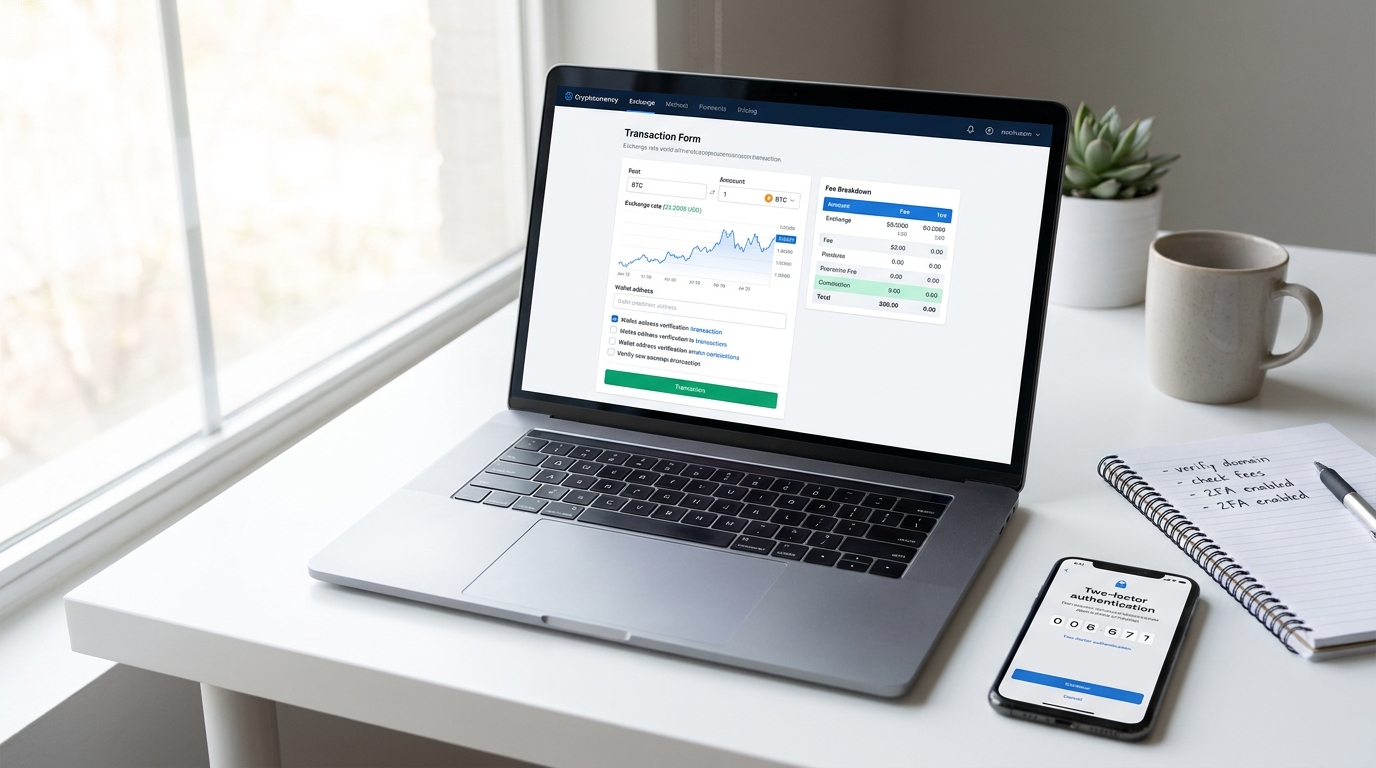
An instant crypto exchange lets you swap one cryptocurrency for another in seconds with minimal steps—but speed does not equal safety. These platforms are popular because they remove friction from trading, yet that convenience often masks significant risks. Before you use one, it’s worth understanding where problems hide: phishing attacks, unfavorable exchange rates, hidden fees, failed refunds, unclear custody of your funds, and withdrawal complications. We’ll cover the mechanics of how instant exchanges work, the biggest safety risks, and a step-by-step verification workflow you can apply to any service. For more context on secure trading infrastructure, consider reviewing altcoin cryptocurrency exchange resources to understand how different platforms manage liquidity and custody.
How Instant Crypto Exchanges Work and Where the Risk Comes From
Instant crypto exchanges operate very differently from traditional order-book exchanges, and understanding those differences is the first step toward safer use. When you trade on a conventional exchange, your order sits in a queue until a matching buyer or seller accepts it. With an instant exchange, the platform quotes you a rate and executes the swap immediately—often within seconds. That speed comes from the exchange absorbing liquidity risk, pre-positioning reserves, or routing your swap through multiple liquidity pools. Each model carries distinct custody, fee, and transparency risks.
| Model | How it works | Main risk | Best for |
|---|---|---|---|
| Instant swap (DEX aggregator) | Quotes best rate across multiple decentralized pools; routes your swap automatically | Slippage, network congestion delays, smart contract bugs, no customer support | Users comfortable with blockchain risk and self-custody |
| Custodial instant exchange | Platform holds your deposit, quotes a rate, sends the output to your wallet | Platform insolvency, account freezes, regulatory seizure, phishing of your account | Users who want speed and simplicity; requires trust in operator |
| Non-custodial instant exchange | You send coins directly to a smart contract or liquidity provider; platform never holds funds | Rate changes between quote and execution, failed transactions, missing refund details | Users prioritizing fund control; requires understanding of blockchain mechanics |
| Fixed-rate service | Platform locks a rate for a set time (often 10–30 minutes); you can review before confirming | Rate lock expires; funds may sit pending if you’re slow to confirm | Users who want certainty and time to verify details |
| Floating-rate service | Platform quotes a rate valid only for 30–60 seconds; final amount may differ if network is congested | High slippage if you confirm after quote expires; unclear final payout until confirmation | Fast traders willing to accept rate variance |
Instant Swap vs. Traditional Exchange
The core difference is abstraction versus transparency. A traditional order-book exchange shows you the exact price, order depth, and spread before you commit. An instant swap hides that detail—you see one rate, and the platform manages execution across liquidity sources. That’s convenient but risky if the platform is quoting you a worse rate than the market, skimming the difference as a hidden fee, or experiencing unexpected slippage on your behalf.
When you request a quote from an instant exchange, you’re seeing the rate it promises to honor—but only if you confirm within the quote validity window (often 30 seconds to 10 minutes). If the network becomes congested or the underlying liquidity pools move significantly, the actual amount you receive can be less than quoted. Some platforms lock the rate in advance (fixed-rate) so you know exactly what you’ll get; others only guarantee execution at a floating rate, meaning the final amount is unknown until after the transaction is confirmed.
The risk escalates when the platform doesn’t clearly separate its own fee from the underlying spread and network costs. You might see a 2% advertised fee but end up losing 4–5% total because hidden slippage and network charges weren’t itemized. Beginners often miss this detail because the UI shows only the final amount, not the breakdown.
Custodial and Non-Custodial Models
Custody is the legal and operational control of your funds. In a custodial model, the exchange holds your coins while it processes the swap. If the platform is hacked, goes bankrupt, or is shut down by regulators, your funds may be frozen or lost. Non-custodial services route your swap directly from your wallet to a liquidity provider or smart contract—you retain control at every step, but you’re also responsible for confirming addresses, memos, and network selections correctly.
Custodial exchanges offer faster customer support because they can reverse transactions, manually refund failed swaps, and recover coins sent to the wrong address. Non-custodial platforms cannot intervene once a transaction is on-chain. You gain sovereignty but lose the safety net of a support team that can undo mistakes.
The legal implications matter too. Custodial exchanges in many jurisdictions must be licensed, comply with AML/KYC rules, and maintain reserves. Non-custodial services occupy a grayer area—some operate without licenses, relying on the argument that they don’t custody funds, only aggregate liquidity. This means they may not have insurance, regulatory oversight, or proof of reserves. The trade-off is speed and lower fees versus reduced accountability.
The Biggest Safety Risks to Check First
Not every instant exchange is risky, but certain warning patterns appear repeatedly in compromised platforms and scams. The table below outlines the most common threats and how to spot them before you use the service.
| Risk | What it looks like | Why it matters | Warning level |
|---|---|---|---|
| Phishing or fake domain | URL similar to but slightly different from the legitimate site; no HTTPS; browser warnings | Scammers steal your deposit; credentials are captured; wallets are emptied after you connect | Critical |
| No KYC or minimal checks | Platform accepts all users, no identity verification, no source-of-funds questions | Higher risk of regulatory shutdown; funds may be frozen; no recourse if your account is compromised | High |
| Unclear custody or transparency | No explanation of who holds funds, how they’re invested, or where swaps are routed; no proof of reserves | You cannot assess whether the platform can actually fulfill large withdrawals | High |
| Delayed or blocked withdrawals | Users report pending withdrawals for days; support is unresponsive; funds eventually disappear | Your money may be frozen indefinitely; the platform may be insolvent or under investigation | Critical |
| Hidden or constantly changing fees | Advertised rate differs from actual payout; fee structure is vague or buried in fine print | You lose money on every transaction without understanding why | Medium |
| Weak or absent customer support | No phone number, email response times exceed 7 days, support is only a chat bot | If something goes wrong, you have no way to resolve it or recover funds | High |
| Forced urgency | “Rate expires in 10 seconds,” “Limited time offer,” buttons that push you to confirm before reviewing | Scammers use urgency to prevent you from double-checking addresses and amounts | High |
| Unregistered or falsely licensed | Claims of regulation but no verifiable registration number; regulator database returns no match | You have no legal recourse if the platform disappears or mishandles your funds | Critical |
Red Flags That Usually Mean Extra Scrutiny Is Needed
Before you complete a swap, scan for these quick warning signs. If you spot more than one, consider using a different platform.
- The rate is significantly better than competitors – if it looks too good to be true, it usually is; legitimate instant exchanges often have rates within 0.5–1% of each other
- The platform requires you to deposit before getting a quote – legitimate exchanges show you the rate upfront; asking for a deposit first is a scam signal
- Support channels are missing or unresponsive – no email, no live chat, no response time guarantee; if something fails, you’re stuck
- The domain is new or has a suspicious registrar – check when the domain was created using WHOIS; new domains (less than 6 months old) combined with attractive rates are a red flag
- No transparency on where your swap is routed – the platform doesn’t explain whether it uses smart contracts, its own liquidity, or third-party providers
- Testimonials or proof of volume are absent or look fake – real platforms publish transaction stats, user reviews on independent sites, and verifiable case studies
- The withdrawal process is intentionally complex – multi-step verification, required documents, manual review for every withdrawal
What to Verify Before You Use an Instant Crypto Exchange
This section outlines a pre-swap verification workflow you can apply to any platform. The steps below are ordered by priority: start with identity and domain checks, then move through rates and fees, and finally review compliance and refund policies.
- Verify the exact domain and use HTTPS – check that the URL matches the platform’s official website (found on their verified social media or a domain registrar); ensure the URL starts with “https://”, not “http://” or a shortened link
- Bookmark the official URL after verifying it – once you confirm the domain is legitimate, add it to your browser bookmarks to avoid accidentally visiting a phishing copy later
- Confirm the app is from the official publisher – if using a mobile app, check the publisher name in your app store and read recent reviews for warnings about phishing or account theft
- Compare the quoted rate against at least two competitors – use a rate comparison tool or manually check a second platform; if the rate differs by more than 2%, ask why before committing
- Identify all fees and network costs before confirming – review the fee breakdown (platform fee, network fee, slippage); calculate the final amount you’ll receive and confirm it matches the platform’s quote
- Double-check your destination wallet address – copy and paste your receiving address from your own wallet, not from a clipboard or email; verify the first and last few characters match
- Confirm the correct network is selected – if swapping to Ethereum, confirm the platform is sending to an Ethereum address (not Polygon, Arbitrum, etc.); wrong network selections result in lost funds
Identity, Domain, and App Checks
The first layer of safety is confirming you’re using the real platform, not a phishing replica. Scammers create fake websites and apps that look identical to legitimate exchanges, down to the logo and color scheme. The only difference is a subtle change to the domain (e.g., “instant-swap.com” instead of “instant-swap.io”) or a fake app uploaded to a third-party app store.
Start by visiting the platform’s official social media accounts (Twitter, Discord, Telegram) and cross-referencing the link they provide. Official accounts often have a blue checkmark or verification badge. If the platform has a blog or press releases, note the domain mentioned there. Once you’ve confirmed the official domain, open a fresh browser tab and type it in manually—do not click a link from an email or search result, as those can be intercepted.
Check the SSL certificate (the padlock icon in your browser) and ensure the domain name in the certificate matches exactly. For mobile apps, open your app store (Apple App Store or Google Play) and search for the platform by name. Verify the publisher name (often the company’s legal name, not a random account) and read recent user reviews. Look for warnings about phishing, account compromises, or fake apps. If the app has very few downloads (under 1,000) or no reviews, it’s likely not the official version.
Rates, Fees, Networks, and Final Destination Checks
Once you’ve confirmed the domain, the next step is understanding what you’re actually paying and what you’ll receive. Instant exchanges quote rates in real time, and those rates are valid only for a short window (usually 30 seconds to 10 minutes). After the quote expires, you must request a new one.
When you see a quoted amount, break it down: the platform fee (often 0.5–2%), the network fee (varies by blockchain; Ethereum is more expensive than Polygon), and any slippage (the difference between the quoted rate and the executed rate due to liquidity conditions). Some platforms show this breakdown clearly; others only show the final amount. If the breakdown isn’t visible, click into the details or review the transaction confirmation carefully.
Pay special attention to the minimum and maximum swap amounts. Instant exchanges often set high minimums ($100–$1,000) to reduce risk. If you’re swapping a small amount, confirm that the platform supports it—trying to swap less than the minimum may trigger a failed transaction and a fee.
Finally, verify your destination wallet address before confirming the swap. Copy the address directly from your receiving wallet (MetaMask, Ledger, Coinbase Wallet, etc.) and paste it into the platform. Never type it manually. Double-check that the address is correct—a typo will send your coins to the wrong wallet forever. For platforms that support multiple networks (Ethereum, Polygon, Arbitrum, etc.), confirm that your destination address is on the correct network. Sending ETH to a Polygon address, for example, will result in lost funds.
KYC, AML, Licensing, and Compliance Signals
Know Your Customer (KYC) and Anti-Money Laundering (AML) requirements have become standard for reputable instant exchanges. These processes ask for identity verification (a government ID, proof of address) and sometimes source-of-funds documentation. Many users dislike KYC because it reduces privacy and creates a paper trail. However, KYC is also a marker of legitimacy—platforms that implement it are taking regulatory compliance seriously and reducing the risk of operating a Ponzi scheme or exit scam.
Platforms with no KYC whatsoever are not automatically dangerous, but they do operate in a legal gray zone. They may be based in unregulated jurisdictions, avoid oversight deliberately, or shut down suddenly if they attract regulatory attention. Additionally, unregulated platforms have no insurance protection and no independent auditor verifying they actually hold the reserves they claim.
How to Judge Whether Compliance Is Real
Determining whether a platform is actually compliant takes a few checks. The table below outlines what good compliance looks like and what signals suggest the platform is cutting corners or misrepresenting itself.
| Check | Good sign | Bad sign |
|---|---|---|
| Licensing or registration | Platform publishes a registration number for a known regulator (FinCEN, FCA, DFSA, etc.); number is verifiable in the regulator’s public database | No registration number; regulator database returns no match; license is claimed but not documented with a link |
| Jurisdiction transparency | Platform clearly states its headquarters and regulated entity; legal terms mention which country’s laws apply | Jurisdiction is unclear; headquarters listed in an unregulated offshore zone; legal terms are vague |
| KYC/AML policy details | Published policy describes what information is required, how long verification takes, and what happens if you fail verification | No policy published; verification requirements are unclear or hidden behind a login; KYC approval times vary wildly without explanation |
| Withdrawal limits | KYC tier determines withdrawal limits; higher limits require higher verification; limits are listed publicly | No published limits; limits change without notice; same limits for all users regardless of verification |
| Privacy statement | Clear description of what data is collected, who can access it, and how long it’s retained; includes a link to a privacy officer or compliance contact | No privacy statement; data-sharing practices are unclear; no way to contact the compliance team |
Fees, Spreads, Slippage, and Rate Transparency
Understanding the true cost of a swap is critical. Instant exchanges often advertise a low platform fee (0.5–1%) but the final cost to you is higher because of spread and slippage. The spread is the difference between the best buy and sell prices in the liquidity pool; slippage is the additional price movement that occurs between the time you get a quote and the time the transaction is confirmed on-chain.
A transparent platform itemizes all costs. A less transparent one bundles them into a single rate, making it impossible to know whether you’re losing money to fees, spread, slippage, or some combination. High slippage often signals low liquidity for that trading pair, meaning the platform had to execute your order across multiple pools and paid a premium to do so.
| Cost factor | Where it appears | How to verify |
|---|---|---|
| Platform fee | Explicitly listed in the swap details; percentage of the swap amount | Check the platform’s fee schedule (usually under Settings or Help); compare against competitors |
| Network fee (gas) | Separate line item showing the blockchain network cost; varies by network congestion | Check a blockchain explorer (Etherscan, PolygonScan) to see typical gas fees for the time of your swap |
| Spread | Implicit in the quoted rate; wider spread means worse rate than market | Compare the quoted output amount against the real-time price on a major exchange like Coinbase or Kraken |
| Slippage | Difference between quoted amount and actual received amount; only visible after transaction confirms | Request a quote, wait 1–2 minutes without confirming, request a new quote, and compare the two amounts |
| Refund fee | Charged only if the swap fails and you request a refund; often 1–5% of the amount | Check the refund policy; ask support before swapping if the fee applies |
Fixed Rate vs. Floating Rate
Most instant exchanges offer both fixed-rate and floating-rate options. Fixed rate means the platform locks in a rate for a set period (often 10–30 minutes). You can review the details, copy your destination address, and confirm when ready. If the network is congested and the transaction takes longer, you still get the locked-in rate. This is safer because you know exactly what you’ll receive.
Floating rate means the rate is only guaranteed for 30–60 seconds. If you confirm after that window, the actual output amount may differ from the quoted amount. Floating rates are usually slightly better (0.1–0.5% better) because the platform isn’t taking on rate-lock risk. However, if network congestion delays your transaction, slippage can work against you, and you may receive significantly less than quoted.
For beginners, fixed rate is the safer choice. The slightly higher fee is worth the certainty. For experienced traders swapping during low-congestion periods, floating rate can save money if you confirm quickly.
How to Confirm the Real Amount You Will Receive
The steps below form a simple calculation workflow to ensure you understand the final payout before confirming.
- Note the quoted output amount – this is the amount the platform promises if you confirm within the quote validity window (e.g., 10 minutes for fixed rate, 30 seconds for floating)
- Subtract the platform fee – if not already deducted, calculate the fee as a percentage and subtract it from the quoted amount
- Subtract the network fee – the platform usually shows this separately; it’s the cost to post the transaction on-chain
- Calculate your expected final amount – this is what you should see arrive in your wallet, assuming no slippage
- Compare against at least one other platform – confirm that the final amount is competitive; if another platform offers 2%+ more, switch
- Check the quote expiry time – note when the quote expires and ensure you have time to review the destination address and confirm without rushing
Refunds, Failed Swaps, and Withdrawal Safety
Even with careful verification, swaps can fail. The blockchain may reject the transaction, you might send funds to the wrong address, or the platform might experience a technical issue. When something goes wrong, your recourse depends on the platform’s refund policy and whether it’s custodial or non-custodial.
Custodial platforms can often reverse transactions and refund your original coins, but only within a limited time window (often 24–48 hours). Non-custodial platforms cannot reverse on-chain transactions; if you sent funds to the wrong address, they’re gone. Some non-custodial services offer insurance or manual intervention for common mistakes (missing memo, wrong chain), but this is rare and usually only for large swaps.
Before you commit to any swap, understand the refund timeline and whether fees are charged. If a swap fails and you request a refund, will you lose 1%, 5%, or nothing? How long does the refund take (instant, 1–3 hours, 1–3 days)? Is the refund fee waived if the failure was the platform’s fault? Most platforms don’t distinguish, meaning you pay a fee even if you did everything right and the platform experienced an outage.
- Refunds are not instant – most platforms require 1–24 hours to process a refund; during that time, your funds are pending and cannot be re-swapped or withdrawn
- Refund fees reduce the amount returned – some platforms charge 1–5% to process a refund, meaning you lose money if the original swap fails
- Manual review may be required for missing tags or memos – if you swap to a coin that requires a memo (like XRP) and forgot to include it, customer support may be able to recover the funds, but this takes days and may not be guaranteed
- Address mismatches are usually not recoverable – if you sent to a wrong address, only the owner of that address can return it; the platform cannot help
Questions to Ask Before Sending Funds
Before confirming a swap, mentally work through these questions. If you can’t answer all of them confidently, do not proceed.
Does the platform have a published refund policy that explains the timeline and any fees? Can you contact customer support (email, chat, phone) and will they respond within 24 hours? If the swap fails, is there a process to manually review it, or is it automatically rejected? Does the platform support the destination network you’re using (e.g., if you want to receive USDC on Polygon, does the platform send to Polygon or only to Ethereum)?
Additionally, review the platform’s withdrawal history if it’s public. On Twitter or Reddit, search for the platform name and “withdrawal” or “refund.” If you find many complaints about delayed withdrawals or missing refunds, that’s a strong signal to avoid it. A few complaints are normal—any platform with many users will have some disputes—but a pattern of unresolved issues is a red flag.
How to Test a Platform Safely Before Committing More Money
The best way to evaluate an instant exchange is to test it with a small amount. This reveals whether the UI is confusing, the quotes are accurate, withdrawal addresses are confirmed correctly, and customer support is responsive. A successful small test transaction gives you confidence that larger swaps will work as expected.
| Test | What to observe | Pass/Fail signal |
|---|---|---|
| Quote stability | Does the quoted rate remain stable for the stated duration? Does it change unexpectedly? | Pass: rate holds for at least 90% of the quote window; Fail: rate drops by >1% before expiry |
| Destination address verification | Did you successfully copy and paste your destination address? Did the platform confirm it before executing? | Pass: platform displays the address for review and requires confirmation; Fail: address is not displayed or confirmation is optional |
| Transaction confirmation speed | How long did the transaction take from confirmation to arrival in your wallet? | Pass: <5 minutes for Ethereum, <1 minute for Polygon/Arbitrum; Fail: >30 minutes without explanation |
| Final amount accuracy | Did you receive the amount quoted, or was there unexpected slippage? | Pass: received within 0.5% of quoted amount; Fail: received <95% of quoted amount |
| Withdrawal success | Were you able to withdraw the swapped coins from the platform to your own wallet without issues? | Pass: withdrawal confirmed within 1 hour; Fail: withdrawal stuck or blocked |
| Support responsiveness | If you had a question, how quickly did support respond? Did they resolve the issue? | Pass: response within 4 hours; clear resolution; Fail: no response within 24 hours or issue unresolved |
Small Test Transaction Workflow
Use this step-by-step process to safely test a platform for the first time.
- Choose a small amount you’re willing to lose – swap between $10–$50; this is enough to catch major issues without significant financial impact
- Perform a quote request and review all fees – note the final amount, platform fee, network fee, and quote expiry time; do not confirm yet
- Copy your destination wallet address – open your wallet in a separate browser window and copy the address; paste it into the platform; verify the first 6 and last 6 characters match exactly
- Confirm the swap and monitor the transaction – after confirming, note the transaction ID (if provided); open a blockchain explorer and search for the transaction to watch its progress
- Verify the arrival and calculate the actual cost – once the coins arrive in your wallet, calculate the final cost: (quoted amount – received amount) ÷ quoted amount × 100 = true fee percentage
- Test a withdrawal if applicable – if the platform required a deposit, ensure you can withdraw the swapped coins without restrictions; check for withdrawal fees
What to Do If Something Looks Wrong
If during the test transaction you notice something unexpected, stop and investigate before attempting a larger swap.
Do not confirm the swap if you notice any of these issues: the destination address is not displayed for review, the quoted amount changes by more than 1% without explanation, the platform is asking for information beyond KYC (like your bank account details for a non-custodial swap), or the fee breakdown is unclear. Instead, close the browser tab and contact customer support through an official channel (not a link in a chat or email, but from the platform’s main website).
Document what went wrong: take screenshots of the error message, note the exact time and swap details, and describe the issue clearly. If support cannot explain or resolve the problem within 24 hours, do not use that platform for a larger amount. A legitimate exchange will acknowledge the issue and provide a clear explanation or compensation (refund, fee waiver, etc.). A scam or poorly run platform will ignore you or blame you for the problem.
—
By following this four-layer safety framework—identity and domain verification, transaction math (rates and fees), compliance checks, and refund policy review—you can confidently evaluate any instant crypto exchange before you use it. The combination of upfront research, a small test transaction, and ongoing attention to warning signs will protect you from phishing scams, unfavorable rates, and platforms that can’t deliver on their promises. Start small, verify every detail, and only increase your transaction size once you’ve confirmed the platform is reliable and transparent.