
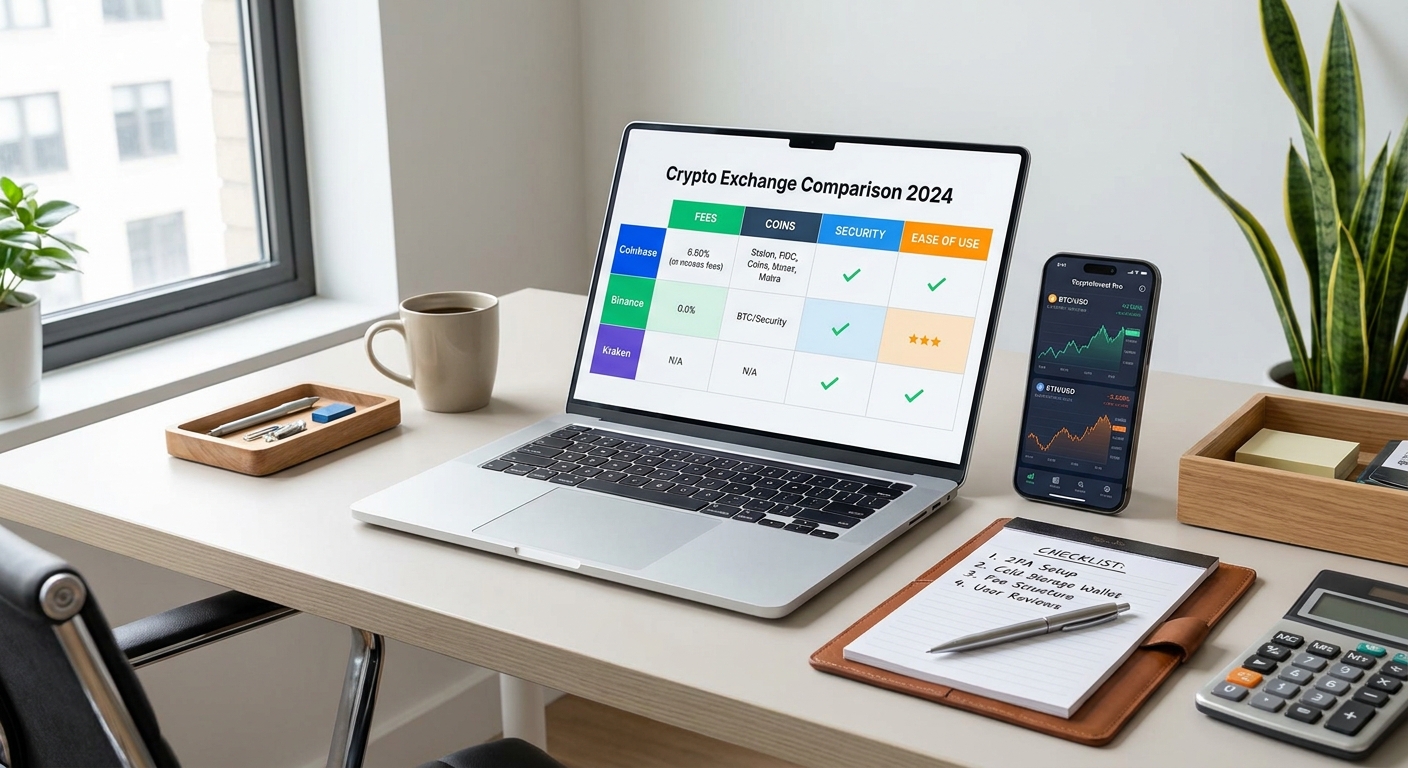
Choosing the right crypto exchange is one of the most important decisions a new or experienced trader can make. With dozens of platforms competing for your business—each claiming to offer the best rates, widest coin selection, or most robust security—it’s easy to feel overwhelmed. The reality is that no single exchange is universally “best”; instead, different platforms excel in different areas depending on your priorities and trading style.
This guide breaks down the four core criteria you should evaluate: fees, coin selection, security, and ease of use. By comparing exchanges across all four pillars rather than focusing on a single metric, you’ll find the platform that truly matches your needs. Whether you’re a beginner making your first purchase, an active trader chasing the lowest maker/taker rates, or an altcoin hunter seeking deep liquidity across emerging tokens, a structured decision framework will save you time and money.
How to Compare Crypto Exchanges
Comparing crypto exchanges requires a balanced approach. Focusing on fees alone might lead you to a platform with excellent trading rates but poor coin selection or frustrating onboarding. Similarly, chasing the broadest coin catalog without checking liquidity or security can expose you to unnecessary risk. The strongest comparison method evaluates all four dimensions together and maps each exchange to specific use cases.
Throughout this guide, you’ll see these four criteria consistently applied:
Fees determine how much each trade costs and include maker/taker rates, deposit charges, and withdrawal expenses. Coin selection reflects the breadth and depth of assets available, plus the liquidity to actually trade them. Security covers cold storage, two-factor authentication, proof of reserves, and regulatory compliance. Ease of use spans onboarding speed, app design, dashboard clarity, and the learning curve for beginners versus professional traders.
Fee Types That Matter Most
Trading costs vary widely across platforms and trading styles. Understanding the key fee categories will help you estimate your true cost per trade.
- Maker and taker fees: The maker fee applies to limit orders that add liquidity to the order book (usually 0.01% to 0.1% per trade). Taker fees apply to market orders that remove liquidity (typically 0.05% to 0.26% per trade). Active traders accumulate these costs quickly, so even a 0.05% difference compounds across hundreds of monthly trades.
- Spreads: The gap between the bid and ask price acts as a hidden cost. Exchanges with poor liquidity in specific trading pairs can widen spreads, especially on altcoins, making each trade more expensive than the displayed fee suggests.
- Deposit and withdrawal charges: Some platforms charge flat fees or percentages for moving fiat currency onto the exchange or withdrawing crypto to your wallet. Bank wire deposits often cost $0–$25, while crypto withdrawals may charge a fixed amount per token.
- Tiered discounts: Most major exchanges offer volume-based fee reductions. If you trade more than $100,000 monthly, you might qualify for 0.05% maker fees instead of 0.1%, saving thousands annually.
- Staking and earning rewards: Some platforms rebate trading fees if you hold their native token (like Binance’s BNB). These can significantly reduce net costs for frequent traders.
What to Check Beyond Fees
Fees are important, but they’re only part of the equation. Coin selection matters because an exchange with ultra-low fees is useless if it doesn’t support the assets you want to trade. Exchanges like Binance and MEXC list 500+ coins, while Coinbase focuses on approximately 150 mainstream assets. More coins don’t always equal better value if liquidity is thin on lesser-known tokens—a large spread will erase any fee advantage.
Security and regulatory compliance directly affect the safety of your funds. Platforms with robust cold storage, proof of reserves audits, and strict KYC (know-your-customer) compliance inspire more confidence than exchanges that operate in gray legal areas. Coinbase and Kraken are often cited for their transparent compliance posture, while newer platforms may prioritize speed over regulation.
Customer support and liquidity are often overlooked but critical. If something goes wrong with your account, responsive support can mean the difference between recovering your funds and losing them. Liquidity determines how quickly you can execute large orders without slippage—a critical concern for traders moving significant capital.
Best Exchanges by Overall Value
The following table compares four major platforms across the four key dimensions. Each exchange has distinct strengths, and the “best” choice depends on your specific situation.
| Exchange | Fees | Coins | Security | Ease of use |
|---|---|---|---|---|
| Binance | Very low (0.1% maker, 0.1% taker at base; discounts available) | Extensive (1,500+) | Strong (cold storage, 2FA, insurance fund) | Moderate (feature-rich but steep learning curve) |
| Coinbase | Higher standard (0.5% taker on app); lower on pro platform (0.04% maker/taker) | Moderate (150+) | Excellent (regulatory focus, insurance, proof of reserves) | Excellent (intuitive app, fast onboarding) |
| Kraken | Low (0.16% maker, 0.26% taker at base; tiered reductions) | Good (200+) | Excellent (cold storage, insurance, security-first design) | Good (professional interface, steeper learning curve) |
| MEXC | Very low (0.02% maker, 0.06% taker base rates) | Very extensive (1,500+) | Good (cold storage, 2FA) | Moderate (feature-rich, less intuitive) |
Who Each Exchange Is Best For
- Binance: Best for active traders and altcoin enthusiasts who want low fees, massive coin selection, and advanced trading tools. The learning curve is steeper, but the platform rewards experience with lower costs and deeper liquidity.
- Coinbase: Best for beginners and security-conscious investors who prioritize ease of use and regulatory compliance over the lowest possible fees. The standard app is very beginner-friendly, though the pro platform offers much lower rates.
- Kraken: Best for traders who want a balance of low fees, strong security, and professional trading features without overwhelming complexity. The security reputation appeals to risk-aware investors.
- MEXC: Best for altcoin hunters and traders seeking the absolute lowest fees. The trade-off is a less polished interface and smaller regulatory footprint compared to Tier 1 exchanges.
Fees Comparison: Trading, Deposits and Withdrawals
This detailed fee table shows how costs accumulate across different transaction types. Figures represent typical starting rates before volume discounts.
| Exchange | Maker fee | Taker fee | Deposit cost | Withdrawal cost |
|---|---|---|---|---|
| Binance | 0.1% | 0.1% | Free (crypto) / varies (fiat) | Network fee only |
| Coinbase | 0.5%+ (app) / 0.04% (pro) | 0.5%+ (app) / 0.06% (pro) | Free (crypto) / 1.49%–1.99% (ACH) | 0–$25 (varies by asset) |
| Kraken | 0.16% | 0.26% | Free (crypto) / varies (fiat) | Network fee + $0–$5 |
| MEXC | 0.02% | 0.06% | Free (crypto) / varies (fiat) | Network fee only |
Where Low-Fee Exchanges Win
For active traders executing 10+ trades per month, maker/taker fees compound quickly. A trader placing $100,000 in monthly spot trades at 0.1% fees pays $100 in commissions. The same trader on MEXC at 0.02%/0.06% rates might pay only $20–$40 monthly, saving $500–$1,000 per year. Over a full year of trading, this difference alone justifies moving to a lower-cost platform. High-volume traders on tiered fee structures can negotiate even better rates, making the fee comparison critical for profitability.
Liquidity amplifies these savings. An exchange with tight spreads on your preferred trading pairs can save far more than the nominal fee difference. Binance and MEXC dominate in altcoin liquidity precisely because their massive user bases create deep order books, allowing you to execute large orders without slippage.
When Higher Fees Can Still Be Worth It
Beginners and conservative investors often find higher-fee platforms valuable despite the cost. Coinbase’s standard app charges approximately 0.5% per trade, roughly 5–10 times higher than Binance’s base rates. However, Coinbase’s regulatory standing, insurance coverage, and intuitive interface eliminate common sources of costly mistakes (forgotten API settings, security lapses, or confusion during volatile markets). For a first-time trader converting $1,000 to Bitcoin, Coinbase’s extra $5 cost is far less important than reducing the risk of account compromise or user error.
Similarly, traders prioritizing security over cost often prefer Kraken, despite mid-tier fees. The exchange’s reputation for security, insurance fund, and responsive support can justify the extra expense, especially for portfolios exceeding $50,000.
Coin Selection and Market Depth
Different users need different coin catalogs. Mainstream investors focus on Bitcoin, Ethereum, and stablecoins; altcoin traders need broad exposure to emerging tokens; and specific use cases (such as staking or DeFi) require particular assets.
| Exchange | Approx. coins | Strength | Best for |
|---|---|---|---|
| Binance | 1,500+ | Fastest new listings, exceptional altcoin depth, large trading pairs | Active traders, altcoin hunters |
| Coinbase | 150+ | Curated, regulatory-compliant assets, institutional-grade | Beginners, conservative portfolios |
| Kraken | 200+ | Balanced mix of mainstream and emerging, strong fiat pairs | Traders seeking variety without excess |
| MEXC | 1,500+ | Rapid listing, deep long-tail altcoin selection | Micro-cap explorers, high-risk traders |
How Coin Breadth Changes the Choice
Choosing between a platform with 150 coins versus 1,500 coins depends on your trading style. A beginner planning to hold Bitcoin and Ethereum indefinitely will never use more than a handful of assets, so Coinbase’s 150-coin limit is irrelevant. An active altcoin trader seeking early access to emerging tokens, however, needs Binance or MEXC, where rapid listing cycles give first-mover advantage.
Liquidity separates serious exchanges from speculative ones. A platform listing 1,500 coins means little if 1,000 of them have low volume and wide spreads. Binance and MEXC maintain liquidity across their full roster through large user bases, while smaller exchanges may list thousands of coins with minimal trading activity. Before choosing an exchange based on coin count, verify that your target assets have reasonable daily volume (usually $100,000+) to ensure you can enter and exit trades efficiently.
Security and Compliance
Security breaches can wipe out years of gains. Comparing platforms on cold storage, two-factor authentication, proof of reserves, and regulatory standing is non-negotiable.
| Exchange | Cold storage | 2FA | Proof of reserves | Regulatory/compliance note |
|---|---|---|---|---|
| Binance | Yes (majority of assets) | Yes (authenticator, SMS) | Published (Mazars audit 2023) | Crypto-friendly jurisdictions; some fiat restrictions |
| Coinbase | Yes (98%+ of customer assets) | Yes (authenticator, SMS, security keys) | Yes (monthly published) | US-regulated (NY BitLicense); FDIC insurance on USD holdings |
| Kraken | Yes (90%+ of customer assets) | Yes (authenticator, SMS, security keys) | Yes (published annually) | US-regulated; strong security audit history |
| MEXC | Yes (majority of assets) | Yes (authenticator, SMS) | Published (periodic) | Cayman Islands-based; lighter regulatory oversight |
Security Features Buyers Should Expect
Before funding any exchange account, verify these baseline protections:
- Cold storage for most assets: At least 80% of customer funds should be held offline, inaccessible to hackers. This is table-stakes for reputable platforms.
- Multi-factor authentication (MFA): Authenticator apps (like Google Authenticator) are superior to SMS-based 2FA, which is vulnerable to SIM-swapping attacks. The best exchanges support hardware security keys as an additional layer.
- Proof of reserves (PoR) audits: Third-party audits verify that an exchange holds enough assets to cover all customer balances. Regular, transparent PoR reports demonstrate financial integrity.
- Insurance and emergency funds: Major exchanges maintain insurance pools or partner with insurers to cover losses from hacks or mismanagement. Coinbase explicitly insures USD holdings up to FDIC limits ($250,000 per account).
- Withdrawal address whitelisting: The ability to designate which wallets can receive withdrawals prevents unauthorized fund transfers even if your login is compromised.
- Account activity alerts: Email or SMS notifications for logins, withdrawals, and API key changes help you detect unauthorized access immediately.
Red Flags in Exchange Safety
Be cautious of exchanges lacking transparency on these critical points. Platforms that don’t publish proof of reserves, refuse to disclose their cold storage percentage, or operate in jurisdictions with no regulatory oversight are higher-risk propositions. Similarly, exchanges that have experienced major hacks without compensating affected users, or that lack clear customer support channels, suggest weak operational maturity.
Avoid exchanges pushing you toward uninsured staking, margin trading, or other risky products without clear warnings. While these features can be legitimate, aggressive promotion combined with poor security fundamentals is a red flag.
Ease of Use and Onboarding
For beginners, a confusing interface can lead to costly mistakes: sending crypto to wrong addresses, accidentally placing market orders instead of limit orders, or getting lost in advanced settings. Ease of use is not a luxury—it’s a practical safeguard.
Comparing platforms on onboarding speed reveals stark differences. Coinbase’s standard app can have you buying Bitcoin within 10 minutes of downloading. Binance requires more verification steps and presents hundreds of trading options immediately, which can overwhelm first-time users. Kraken offers a middle ground: slightly more setup than Coinbase but a clearer beginner/pro distinction than Binance.
Mobile app quality also varies significantly. Coinbase’s mobile experience is nearly identical to the web app, making it intuitive for phone-based traders. Binance’s mobile app mirrors the web platform’s full feature set, which is powerful but can feel cramped on a small screen.
Dashboard clarity matters when you’re managing money. Coinbase clearly separates your portfolio, recent transactions, and account settings. Binance’s dashboard, by contrast, is highly customizable but requires time to organize. For a $500 first purchase, Coinbase’s simplicity saves stress; for a trader managing a $1M portfolio across multiple pairs, Binance’s flexibility is worth the learning curve.
Best Choices by Experience Level
First-time buyers should prioritize Coinbase. The onboarding is fast (15–30 minutes), the app is intuitive, and the regulatory standing reduces anxiety about fund safety. Accept that you’ll pay slightly higher fees for this peace of mind; as you gain experience, you can migrate to lower-cost platforms.
Active traders should evaluate Binance and MEXC for fee advantages. Both platforms have learning curves, but they reward time investment with tools like advanced charting, API access, and custom alerts. If you’re placing 10+ trades daily, the fee savings alone justify spending a day mastering the interface.
Security-focused investors with significant capital (>$100,000) should seriously consider Kraken. The platform’s insurance fund, regulatory compliance, and transparent security audits appeal to risk-aware participants. Yes, fees are slightly higher than Binance, but the insurance coverage and professional support justify the premium for large portfolios.
Best Exchange for Different User Needs
Rather than declaring one exchange universally superior, this table maps platforms to specific goals.
| Need | Best exchange | Why it fits | Tradeoff |
|---|---|---|---|
| Cheapest trading | MEXC | 0.02%/0.06% base rates, no deposit fees | Less mainstream, smaller support team |
| Safest reputation | Coinbase | Regulatory compliance, insurance, PoR audits | Higher standard fees (0.5% taker) |
| Most coins | Binance | 1,500+ assets with deep liquidity | Steep learning curve, complex interface |
| Easiest onboarding | Coinbase | Intuitive app, fast verification, clear design | Limited to 150 mainstream coins |
| Best for altcoins | Binance or MEXC | Earliest listings, deepest liquidity | Requires account management skills |
| Best balance | Kraken | Low fees (0.16%/0.26%), strong security, 200+ coins | Mid-tier fees, smaller coin selection |
Beginner Recommendation Path
Follow these steps to find the right exchange as a first-time buyer:
- Identify your primary goal: Are you buying and holding Bitcoin long-term, actively trading altcoins, or seeking the safest platform? Your answer narrows the field immediately.
- Check your coin needs: If you only want Bitcoin and Ethereum, Coinbase is sufficient. If you’re interested in altcoins, you’ll need Binance or MEXC eventually, though starting with Coinbase isn’t wrong.
- Test the onboarding: Visit the platform’s app store or website and begin the signup process (don’t fund it yet). Which interface feels more comfortable? Account setup experience is a strong indicator of overall usability.
- Verify security basics: Confirm that the platform supports authenticator-based 2FA, maintains cold storage, and publishes proof of reserves. All four platforms in this guide meet these minimums.
- Start small and diversify: Fund your chosen exchange with $100–$500 as an initial test. After executing a few trades and growing comfortable, you can add more capital or open secondary accounts on lower-cost platforms to optimize fees.
Trader Recommendation Path
Experienced traders should follow a different prioritization. Start by calculating your expected monthly trading volume and fee impact. If you’re executing $500,000 in monthly trades, a 0.1% fee difference costs $500/month ($6,000/year)—large enough to justify switching platforms. Map your target coins across Binance, MEXC, and Kraken to ensure all assets have sufficient liquidity. Then open accounts on the two platforms offering the lowest fees for your specific trading pairs. Many pro traders run two accounts in parallel: Binance for altcoins and MEXC for ultra-low-fee pairs, executing high-volume trades where each platform excels.
Final Decision Checklist
Before opening an account and funding it, work through this practical checklist:
- List your top 5 trading pairs: Write down the specific coins and fiat pairs you plan to trade (e.g., BTC/USD, ETH/USD, LINK/BTC). Verify that all five pairs are available on your shortlist exchanges and have adequate trading volume (>$100,000 daily).
- Calculate your expected fee cost: Multiply your expected monthly trading volume by the maker/taker rates for each platform. Even a 0.05% fee difference compounds significantly if you trade frequently.
- Verify security features: Confirm that 2FA (authenticator-based), cold storage, and withdrawal address whitelisting are available. Skip any platform lacking these baseline protections.
- Check regulatory standing: Search the exchange name + “regulation” or “compliance” to identify any major red flags, ongoing lawsuits, or jurisdictional restrictions that might affect your access.
- Test customer support responsiveness: Visit the exchange’s support chat or forum and ask a simple question. Response time and clarity indicate support quality—critical if issues arise later.
- Compare onboarding speed: Complete (but don’t fund) the verification process on your top two choices. Note which is faster and which interface feels more intuitive.
- Evaluate coin breadth for your plan: Cross-reference your target coins against each platform’s full listing. If a critical coin is missing, that platform is disqualified.
How to Narrow the Shortlist Fast
Start by eliminating platforms that don’t support your required coins or charging fees you find unjustifiable. If you trade altcoins but only want a beginner-friendly experience, Binance is disqualified (too complex) despite its advantages. If you prioritize security and don’t trade altcoins, MEXC is unnecessary (its primary advantage is exotic coins). Once you’ve eliminated poor fits, you’re likely left with one or two strong options. Open accounts on both finalists, fund them with small amounts, and trade live for a week. Real-world experience using the platform, placing orders, and executing withdrawals reveals more than any article comparison.
The strongest choice balances all four criteria—fees, coins, security, and ease of use—according to your specific priorities. By working through this framework rather than hunting for a universally “best” exchange, you’ll find the platform that genuinely serves your trading goals.